
Market Reports
Research, insights, and data on Cambodia's digital economy — free to download.

Cambodia Digital Economy and Society Policy Framework 2021–2035 — Khmer Edition
Explore Cambodia’s long-term vision for developing a digital economy and society through this Khmer-language policy framework. Prepared by the Supreme National Economic Council in May 2021, the document sets out priorities for digital adoption and transformation across government, citizens and businesses. The framework connects two foundations—infrastructure supporting digital transformation, and trust and confidence in digital systems—with three pillars: digital citizens, digital government and digital businesses. Its approach emphasizes that technology must be accompanied by human capabilities, accessible services and an environment that supports responsible digital participation. For business owners, managers, educators and students, the publication provides context for understanding how digital skills, entrepreneurship, public services and infrastructure contribute to national development. It also offers a reference for considering the capabilities organizations and individuals need to participate in the digital economy. From BKD Academy’s educational perspective, the framework reinforces the relevance of practical skills development linked to workplace needs and business applications. Its priorities can inform discussions about digital literacy, leadership and workforce readiness. Read the full Khmer-language document to explore its vision, policy measures and implementation arrangements for 2021–2035. This publication presents a strategic policy framework, rather than a market survey or an evaluation of completed results.
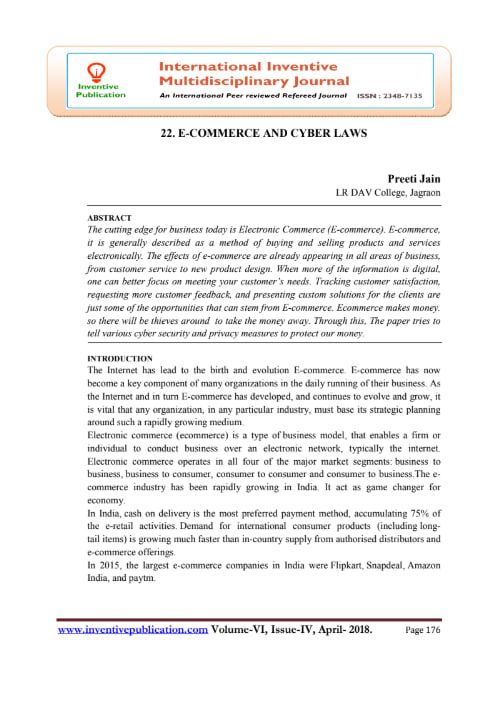
E-Commerce and Cyber Laws: Online Business, Security and Privacy
How do security and privacy concerns affect online business? “E-Commerce and Cyber Laws,” an article by Preeti Jain published in April 2018, introduces e-commerce models and discusses risks associated with digital transactions, mobile banking and the handling of customer information. The paper uses a descriptive research approach based on secondary sources, including books, news articles and websites. Its discussion centers on India’s e-commerce and digital-payment environment, covering business-to-business, business-to-consumer, consumer-to-consumer and consumer-to-business transactions. Despite its title, the article focuses mainly on security awareness and practical precautions rather than detailed analysis of legislation. Topics include phishing, malicious applications, outdated operating systems, insecure network connections, authentication, encryption, backups and mobile and cloud data protection. The author emphasizes customer education and continued attention to emerging threats. For entrepreneurs, employees and students, the article offers an introductory reference for discussing how digital business adoption relates to customer trust and information security. Cambodian readers can use it for comparative learning, while recognizing that its examples and market figures concern India and reflect an earlier period. Read the full English-language article to explore its discussion. Published in 2018, it should be treated as a historical educational resource; technical recommendations require checking against current standards before application.

Cambodia Country Profile 2025: Economic Trends, Key Industries and Business Environment
What opportunities and challenges shape Cambodia’s business landscape? PROFITENCE’s Cambodia Country Profile 2025 brings together demographic, macroeconomic and industry analysis to help readers understand the country’s economic structure and development priorities. The report examines population and workforce characteristics, education, trade and economic trends. It provides dedicated analysis of five sectors: garment, footwear and travel goods manufacturing; agriculture and agro-processing; infrastructure and construction; tourism and hospitality; and financial and banking services. Additional sections explore Industry 4.0, the digital economy, e-commerce, investment legislation and the business environment. Across these themes, the report highlights the potential associated with Cambodia’s young population, infrastructure development and digital adoption. It also discusses constraints, including skills gaps, dependence on concentrated export markets, uneven development and institutional capacity limitations. Its analysis emphasizes the importance of human capital, economic diversification and stronger digital capabilities. For business owners, managers, investors, educators and students, this publication offers a starting point for understanding how national trends connect with sector opportunities and business planning. From BKD Academy’s educational perspective, its discussion of workforce readiness and digital transformation provides context for identifying relevant training and professional-development needs. Read the full English-language report to explore its analysis and supporting sources. The cover identifies the September 2025 edition, while the document states that it was updated on 26 October 2025. Historical figures, estimates and projections should be interpreted according to their stated dates.
E-Commerce in Cambodia 2024: Consumer Trends, Industry Insights and Business Opportunities
What drives online purchasing in Cambodia, and what prevents customers from buying with confidence? PROFITENCE’s E-Commerce in Cambodia 2024 report explores consumer behavior, digital payments, social commerce, logistics and the wider conditions shaping online business. Prepared by PROFITENCE (Cambodia) Co., Ltd., the report combines desk research, a nationwide survey of 1,100 respondents conducted through online and face-to-face methods, and industry-expert interviews. It examines 12 industries, including banking and finance, food and grocery delivery, logistics, consumer electronics, online education, fashion, and beauty and cosmetics. Among the surveyed respondents, 52% identified social media as their main online purchasing channel. Promotions, convenience and price feature among purchasing motivations, while fraud, product quality and additional delivery fees emerge as concerns. These findings reflect the survey respondents rather than national market shares. The report recommends that businesses adapt their services to local preferences, strengthen cybersecurity and data protection, improve payment options and address last-mile delivery challenges. It also discusses policy and infrastructure priorities supporting wider participation in e-commerce. For business owners, marketers, entrepreneurs and training providers, this publication offers a reference for reviewing customer experience, sales channels and digital capabilities. Read the full report to explore its sector analysis and recommendations. The report is the 2024 edition and carries a 2025 copyright notice; its estimates and projections should be read in their original time context.
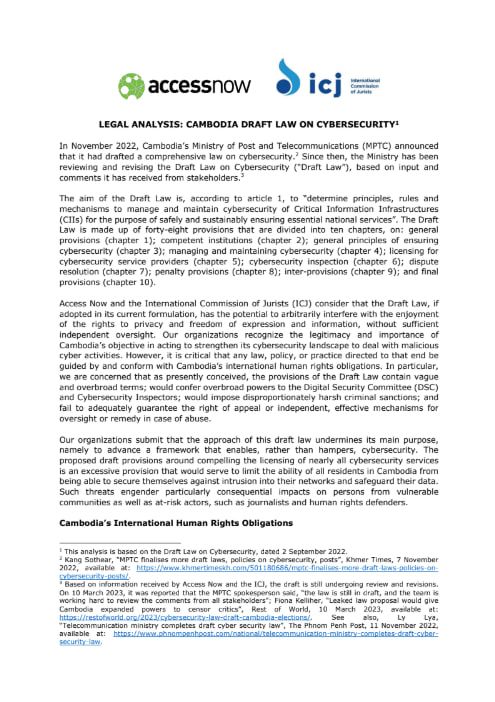
Legal Analysis: Cambodia’s Draft Law on Cybersecurity
How can cybersecurity regulation protect essential services while safeguarding privacy and freedom of expression? This legal analysis by Access Now and the International Commission of Jurists examines Cambodia’s Draft Law on Cybersecurity, specifically the version dated 2 September 2022. The organizations recognize the importance of strengthening cybersecurity but raise concerns about the draft’s definitions, institutional powers, licensing requirements, compliance obligations and proposed sanctions. Their analysis considers how these provisions could affect individuals, businesses, media organizations and civil society. Key issues discussed include access to computer systems and data, the designation of critical information infrastructure, licensing for cybersecurity services and the availability of independent oversight and effective remedies. The authors also question whether the proposed obligations and penalties adequately account for the capacity of smaller organizations. The report recommends withdrawing or substantially amending the examined draft to address these concerns and align cybersecurity measures with international human rights standards. For business owners, digital professionals, educators and students, the document offers a reference for considering the relationship between cybersecurity, regulatory clarity, organizational responsibilities and digital rights. Its findings and recommendations represent the assessment of the two authoring organizations. Read the full English-language analysis to explore their reasoning. This document examines a specific historical draft; it should not be used as confirmation of Cambodia’s current cybersecurity legislation or present compliance requirements.
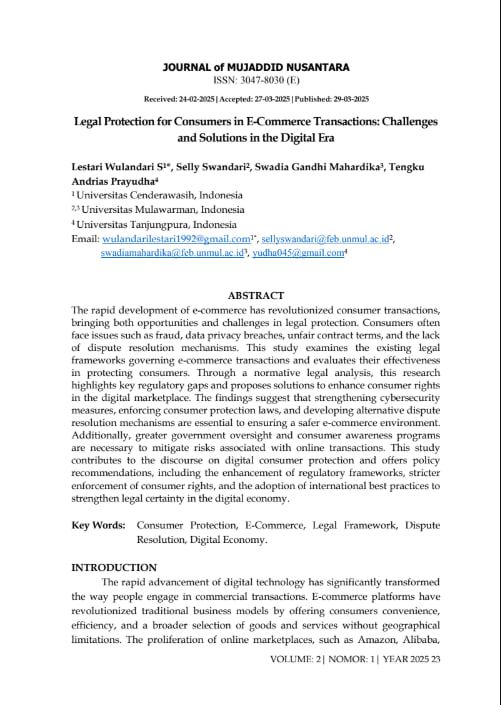
Legal Protection for Consumers in E-Commerce Transactions: Challenges and Solutions in the Digital Era
How can consumers be better protected when shopping online? This academic article examines legal challenges in e-commerce, including fraudulent sellers, misleading advertising, personal data risks, unfair contract terms and difficulties obtaining redress. Published in the Journal of Mujaddid Nusantara in March 2025, the paper uses a qualitative, doctrinal legal research approach based on legal documents and existing literature. Its discussion focuses primarily on Indonesia, with references to international consumer-protection and data-privacy frameworks. The authors argue that effective protection requires more than legislation alone. Their recommendations include stronger enforcement, clearer product information and transaction terms, greater platform accountability, consumer education and accessible dispute-resolution mechanisms. The paper also discusses cross-border cooperation and online mediation and arbitration as approaches to addressing disputes in digital commerce. For business owners, marketers, customer-service teams and students, the article provides material for considering how transparency, responsible data handling and complaint management relate to customer trust. For Cambodian readers, its value lies in comparative learning; its discussion of Indonesian legislation should not be interpreted as Cambodian legal requirements. Read the full English-language article to explore the authors’ analysis and recommendations. This publication is an academic legal study, rather than a Cambodia-specific market survey or a complete business compliance guide.
Cambodia’s Law on Consumer Protection
Cambodia’s Law on Consumer Protection establishes a framework for protecting consumers’ rights and interests, promoting fair competition and strengthening confidence between consumers and businesses. This English-language document provides a reference for understanding the law’s provisions and their relevance to business conduct. The law addresses dishonest acts, misleading representations, deceptive sales practices and consumer information standards. It covers issues relevant to marketing and sales, including advertising, promises of gifts and prizes, bait advertising and false descriptions of goods. It also provides mechanisms relating to consumer associations, complaints, investigations, decisions and sanctions. For business owners, marketers, sales teams and customer-service professionals, the document offers a starting point for examining how products and services are presented to customers. Its provisions highlight the importance of accurate information, honest promotional messages and fair dealings throughout the customer relationship. From BKD Academy’s educational perspective, understanding consumer protection can complement practical training in marketing, sales and business management. It encourages learners to consider both the effectiveness of their communications and the responsibility to avoid misleading customers. Read the attached document to explore the law’s provisions in detail. This is a legal reference rather than a market research report. For specific legal interpretation, readers should consult the authoritative Khmer text and relevant implementing regulations.
Protection Against Digital Crimes in E-Commerce Transactions
Protecting customer information is an important part of building trust in online commerce. This 2025 academic article examines personal data protection and digital crime in e-commerce, focusing primarily on Indonesia’s legal context alongside discussion of international regulatory approaches. The authors describe a normative-empirical legal approach combining legal analysis, existing literature and case studies. The discussion considers risks such as data theft, phishing, malware and unauthorized use of personal information, as well as challenges associated with enforcement and cross-border transactions. The paper argues for a coordinated approach combining legal protection, organizational responsibility and technical safeguards. Its recommendations emphasize stronger data-security practices, clearer regulatory implementation and protection for consumers using digital platforms. For business owners, managers, educators and students, the article offers discussion material on the relationship between customer trust, cybersecurity and responsible handling of personal information. For Cambodian readers, its relevance is comparative: it can inform questions about business practices and digital skills, while its analysis of Indonesian legislation should not be treated as Cambodian legal requirements. Read the full article to explore the authors’ discussion and recommendations. This publication is an academic legal analysis, rather than a Cambodia-specific market survey or a practical compliance manual.
Cambodia Digital Economy and Society Policy Framework 2021–2035
How does Cambodia plan to connect digital technology with economic growth, business competitiveness and social well-being? The Cambodia Digital Economy and Society Policy Framework 2021–2035 sets out the Royal Government of Cambodia’s long-term direction for digital development. Prepared by the Supreme National Economic Council in May 2021, it addresses digital adoption and transformation across government, citizens and businesses. The framework is organized around two foundations: infrastructure supporting digital transformation, and trust and confidence in digital systems. These support three pillars: digital citizens, digital government and digital businesses. Together, they connect technology investment with human capabilities, public services, entrepreneurship and business development. For entrepreneurs, managers, educators and training providers, the document offers a reference for understanding the relationship between digital skills and wider economic development. Its priorities encompass digital leadership, talent development, digital literacy, enterprise digitalization and the conditions needed for businesses to adopt technology. From BKD Academy’s educational perspective, the framework reinforces the importance of preparing people to apply digital knowledge in practical settings. Relevant training can help learners connect technology with everyday work, business needs and responsible participation in the digital economy. Read the full English-language document to explore Cambodia’s digital-development vision, strategic priorities, policy measures and implementation arrangements for 2021–2035. This is a policy framework outlining intended directions and actions, rather than a market survey or an assessment of results achieved.
Cambodia’s Law on Electronic Commerce
Cambodia’s Law on Electronic Commerce provides a legal framework for electronic communications and transactions. Its purposes include establishing legal certainty for electronic civil and commercial transactions and strengthening public confidence in electronic communications. The document addresses the legal recognition of electronic communications, requirements relating to electronic signatures, retention of electronic records and the formation of contracts through electronic means. It explains the conditions under which electronic information can fulfill requirements traditionally associated with written documents and signatures. For entrepreneurs, online sellers, business managers and students, this publication offers a useful starting point for understanding the legal foundations of electronic commerce in Cambodia. It helps readers recognize why reliable records, clear transaction processes and appropriate electronic-signature practices matter when conducting business online. BKD Academy shares this document as an educational and business reference. Readers should consult the relevant provisions, applicable implementing regulations and subsequent legal developments when assessing a specific transaction or business activity. Read the attached Khmer-language document to explore the law’s provisions in detail. This publication is a legal reference, rather than a market research report or a complete compliance guide.
ASEAN Digital Masterplan 2025
The ASEAN Digital Masterplan 2025 outlines a regional framework for strengthening Southeast Asia’s digital economy and society. It connects investment in digital infrastructure with trusted services, business capabilities and wider participation, recognizing that connectivity alone is insufficient to deliver the full benefits of digital transformation. The masterplan identifies eight desired outcomes spanning pandemic recovery, broadband connectivity, trusted digital services and consumer protection, competitive digital-service markets, e-government, cross-border trade, digital capabilities and digital inclusion. It also presents enabling actions, an implementation timetable and proposed measures of success. For business owners, educators and enterprise-support organizations, the sections on skills and technology adoption are particularly relevant. Proposed actions include advancing ICT qualifications, developing advanced digital skills, supporting digital startups and helping citizens and businesses acquire the skills and confidence to use digital services. The document also addresses affordability and access barriers affecting underserved communities. For Cambodian readers, this publication provides a useful reference for examining the relationship between skills development, business competitiveness and inclusive digital participation. BKD Academy’s perspective is that these priorities reinforce the importance of practical training connected to real business needs. Read the full document to explore ASEAN’s digital-development priorities and proposed actions for the period leading to 2025. This is a strategic planning document, rather than an assessment confirming that its intended outcomes were achieved.